

Preventing Falling Objects in Singapore: Worksites, Façades and Rope Access
In Singapore, preventing falling objects is a legal duty shared by the occupier, the employer and the principal. On worksites the occupier must provide adequate overhead protection, scaffolds need toe-boards of at least 90 mm and overlay nets, and debris must go down chutes, not over the edge. Breaches carry fines of up to S$50,000 and two years' jail. Owners must also keep exterior features securely fixed.
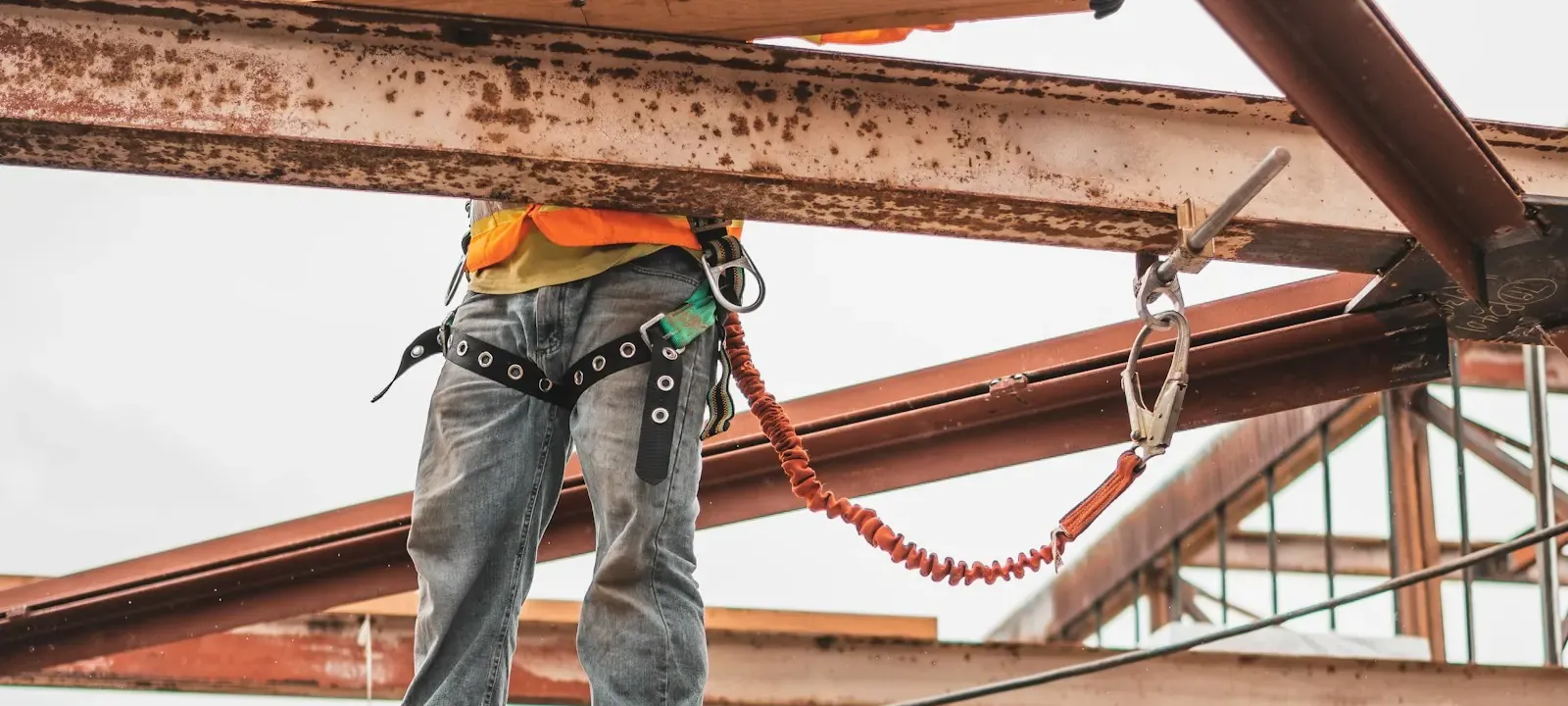
A spanner dropped from 30 storeys does not need to be heavy to kill. Neither does a loose tile, a squeegee, an offcut of aluminium or a corroded bracket. Falling objects are one of the oldest hazards in construction and building maintenance. They are also unusual among workplace hazards because their victims are often not workers at all: pedestrians, shoppers, residents and drivers who had no idea work was going on above them.
When the WSH Council published its Guidelines on Safeguarding Against Falling Objects in 2021, it described being struck by falling objects (SBFO) as statistically the second most common cause of workplace fatalities in Singapore.2 The numbers have improved since. MOM recorded two SBFO deaths in 2025, against five in 2024.1 But the hazard has not gone away. It moves wherever work at height goes: onto façades, rooftops and atriums of occupied buildings.
This guide covers what the statistics show, which regulations require toe-boards, nets, overhead protection and debris control (and which do not), the duties of owners, occupiers and MCSTs, the separate regime for objects falling from completed buildings, how to build a falling-object prevention plan, and the specific controls that matter for rope access.
2 workplace deaths from being struck by falling objects in 2025, down from 5 in 20241
What the statistics show
MOM’s annual Workplace Safety and Health Report classifies injuries by incident type. “Struck by falling objects” sits among the Type A incidents, the higher fatality-risk group.1
| Measure (all industries) | 2024 | 2025 |
|---|---|---|
| Fatal injuries, struck by falling objects | 5 | 2 |
| Major injuries, struck by falling objects | 36 | 28 |
| Minor injuries, struck by falling objects (previous series) | 946 | 802 |
| Minor injuries, struck by falling objects (new series, any medical leave or light duties) | 1,619 | 1,502 |
| Most common agent listed for major SBFO injuries | Metal items (9) | Metal items (9) |
Source: MOM, Workplace Safety and Health Report 2025, Tables 3d, 4e and 5e.1
By sector, struck-by-falling-objects incidents caused 9 fatal and major injuries in construction and 8 in manufacturing in 2025.1 Of the two fatalities in 2025, one was in transportation and storage and one in professional, scientific and technical activities.1
In September 2026, MOM told Parliament there had been one SBFO fatality from January to August 2026, in August. It identified the common contributing factors as equipment failure, unsafe worker behaviour or work procedures, and poor housekeeping. MOM said its inspectors check for falling-object hazards during routine inspections, such as inadequate scaffold netting that fails to stop tools, loose materials and debris falling onto workers below.3
Two cautions apply when reading these figures. First, MOM’s statistics count workplace injuries. A passer-by struck by a falling window or a piece of killer litter may not appear in them at all. Second, small numbers swing from year to year. A fall from 5 to 2 deaths is welcome, but it does not show the hazard is controlled.
The law on worksites: what is required, and by whom
Falling-object controls on worksites are scattered across several regulations under the Workplace Safety and Health Act 2006 (WSH Act). It helps to separate people falling (the Work at Heights Regulations) from things falling (mainly the Construction and Scaffolds Regulations).
The general duties in the WSH Act
- Occupier (s 11): take reasonably practicable measures so that the workplace, its access and egress, and anything kept there are safe for every person within those premises, whether or not at work.8
- Employer (s 12(2)): take reasonably practicable measures to ensure the safety and health of persons who are not its employees but may be affected by its work. This is the duty that protects the public below a façade job.8
- Principal (s 14A): for contractors engaged since 1 September 2011, take reasonably practicable measures to ensure the contractor has the necessary expertise and has taken adequate safety measures, including checking experience, training and any required licences.8
- General penalty (s 50): where no specific penalty applies, up to S$200,000 or two years’ jail for an individual, and up to S$500,000 for a body corporate.8
The Construction Regulations 2007
The Workplace Safety and Health (Construction) Regulations 2007 apply to worksites and contain the clearest falling-object rules.5
- Reg 24, storage near edges. The employer or principal must ensure materials and equipment are not stored, stacked or placed so close to an opening or edge of a floor, scaffold, platform or structure that they endanger persons below.
- Reg 25, overhead protection. The occupier must ensure adequate overhead protection is provided in the worksite against objects that could fall on or otherwise hit persons.
- Reg 47, cantilevered and material platforms. Every open side from which a person could fall more than 2 m must have guard-rails and toe-boards.
- Reg 50, debris. Debris must not be allowed to accumulate so as to be a hazard.
- Reg 51, removal. Debris, bricks and other materials must be removed by chutes, buckets, hoists or another method that will not endanger anyone.
- Reg 52, debris openings. Openings used to remove debris must be enclosed from floor to ceiling on every floor except the top or working floor. Where that is impracticable, they must be barricaded so that no one can come within 6 m horizontally of an opening through which debris is being dropped.
- Regs 53–55, chutes. Chutes must be fully enclosed except at their openings, of sound construction and rigidly supported, and must discharge into an enclosed debris collection area.
Breaching regs 24, 25, 47(1), 50, 51, 52, 53, 54 or 55 without reasonable excuse can lead to a fine of up to S$50,000, two years’ jail, or both (reg 141(3)).5
The Scaffolds Regulations 2011
The Workplace Safety and Health (Scaffolds) Regulations 2011 (S 518/2011) apply to scaffolds in any workplace, not only construction sites.4
- Reg 22, toe-boards and guard-rails. Every side of a work platform from which a person could fall more than 2 m must have toe-boards and two or more guard-rails. They must be sound, strong enough to withstand impact, fixed inside the uprights, and placed to prevent the fall of any person or material. The top guard-rail must be at least 1 m above the platform, gaps between rails must not exceed 600 mm, and toe-boards must be at least 90 mm high.
- Reg 23, overlay and screening nets. Any timber or metal scaffold erected on the outside of a building must be enveloped with overlay or screening nets. Tower scaffolds are excepted.
- Reg 24, clearing scaffolds. The occupier must remove any material, including waste and debris, from a scaffold that may endanger anyone.
The duty under regs 22 and 23 falls on the “responsible person”, meaning the employer of the person doing the scaffold work or the principal directing it. Breach carries a fine of up to S$50,000, two years’ jail, or both (reg 62(1)).46
The Work at Heights Regulations 2013: what they do and do not cover
The Work at Heights Regulations are often assumed to contain the toe-board and tethering rules. They mainly protect people from falling.7
- Reg 9 requires guard-rails or barriers provided by the occupier to be of sound construction, secured, with the top rail at least 1 m high and gaps of no more than 600 mm. It does not mention toe-boards.
- The definition of a fall arrest system includes a safety net. That is a net to catch a falling person, not debris.
- Regs 29–30 set out the industrial rope access rules discussed below.
- Since 1 June 2024, most core duties carry a fine of up to S$50,000, two years’ jail, or both (reg 31(1)), after MOM raised the ceiling for WSH subsidiary legislation offences from S$20,000.79
Statutory rule or guidance? A quick map
| Control | Statutory requirement? | Source | Duty holder |
|---|---|---|---|
| Overhead protection on a worksite | Yes | Construction Regs reg 255 | Occupier |
| No materials stored near edges or openings | Yes | Construction Regs reg 245 | Employer or principal |
| Toe-boards of at least 90 mm on scaffold platforms (fall over 2 m) | Yes | Scaffolds Regs reg 224 | Responsible person (employer or principal) |
| Toe-boards on cantilevered and material platforms (fall over 2 m) | Yes | Construction Regs reg 475 | Occupier |
| Overlay or screening nets around external scaffolds | Yes | Scaffolds Regs reg 234 | Responsible person |
| Debris by chute, bucket or hoist; enclosed chutes | Yes | Construction Regs regs 51, 53–555 | Employer or principal; occupier |
| 6 m barricade around unenclosed debris openings | Yes | Construction Regs reg 52(2)5 | Occupier |
| Tool tethers, tie-downs, tool bags | Guidance | WSH Council Guidelines2 | Employer, as part of reasonably practicable measures |
| Safety nets or catch platforms under work areas | Guidance (engineering control) | WSH Council Guidelines2 | Employer, occupier |
| Cordoning off below work at completed buildings | MOM guidance | MOM circular, 201810 | Owners, Town Councils, MCSTs and contractors |
| Exclusion zones during lifting | Guidance | WSH Council Guidelines2 | Employer, lifting supervisor |
“Guidance” does not mean optional in practice. The WSH Act duties are qualified by what is “reasonably practicable”, and recognised industry guidance is strong evidence of what was practicable. An employer that ignores the WSH Council’s own guidelines will find it hard to argue it did all that was reasonably practicable.
The WSH Council’s guidance on falling objects
The WSH Council’s Guidelines on Safeguarding Against Falling Objects (August 2021) are the main Singapore guidance document. They apply across industries, from construction to warehousing.2 They are built on the hierarchy of control: elimination, substitution, engineering controls, administrative controls, and personal protective equipment (PPE) last.
| Level | WSH Council examples | Notes |
|---|---|---|
| Elimination | Install air-con compressors near ground level so no one works at height to install or maintain them | Removes both the fall risk and the falling-object risk |
| Substitution | Use prefabricated or precast components assembled on site | Reduces time spent at height on formwork, rebar and plastering |
| Engineering controls | Safety nets and catch platforms under work areas; overlay nets on scaffolds; toe-boards; panelling where items could pass over toe-boards; enclosed debris chutes | Nets and platforms must be strong enough for the impact, and wide enough to catch the falling item |
| Administrative controls | Safe work procedures; housekeeping; controlled lowering instead of throwing; no-entry areas with barricades, signs or sentries during lifting; never lifting loads over people; scheduling lifts when fewer people are around | Needs supervision and enforcement to work |
| PPE | Safety helmets | Only a marginal degree of protection, usually adequate only for light falling objects |
Source: WSH Council Guidelines on Safeguarding Against Falling Objects, 2021.2
On tools, the Guidelines recommend tethers and tie-downs such as lanyards, straps and slings. Tethers should be secure and durable, and preferably purpose-designed rather than improvised add-ons, so they do not detach or impair the tool. Tool bags, belts and pouches keep hands free for climbing and stop small items from being dropped.2
On risk assessment, the Guidelines note that under the WSH (Risk Management) Regulations every workplace should conduct risk assessments for routine and non-routine work. Their summary of the process says to keep records for at least three years and review them at least every three years, after any accident, or when work processes change.2
Falling objects from completed buildings
Not every falling object comes from a work activity. Windows, air-con brackets, tiles, cladding, sunshades and planters fall because they have deteriorated. That is governed by a different regime under the Building Control Act, administered by BCA.
- Duty to keep exterior features secure. Since 1 October 2025, s 25H makes it an offence for the person responsible for an exterior feature to fail to keep it securely fixed so that it, or its support, will not collapse. The maximum is S$20,000, 12 months’ jail, or both. If a feature has fallen and shows deterioration not caused by accident or acts of nature, failure is presumed.11
- Who is responsible. Usually the owner of the premises. For HDB common property it is the Town Council, and for strata common property the MCST or its managing agent. For windows, grilles and shutters forming part of a flat, it is the flat owner or the person with daily charge.11
- Notices to maintain. BCA can order inspection and repair and, if ignored, do the work and recover the cost.11
- Reporting. An exterior feature that injures or kills someone, or dislodges and damages other property, must be reported to BCA within 6 hours.12
- Periodic Façade Inspection. Buildings taller than 13 m and older than 20 years must have their façades inspected every seven years. Any loose or dangling element found must be removed immediately.13
Our guides cover each part of this in detail: window safety, air-con brackets and other exterior features, the Periodic Façade Inspection, and popped and debonded tiles.
Residents add a third source of falling objects: items placed on ledges, parapets and air-con ledges, and high-rise littering. MND has told Parliament that HDB carries out enforcement checks on potential killer-litter objects on air-con ledges where necessary.14 For MCSTs, by-laws and regular estate walks are the practical controls.
The owner’s and occupier’s duty when work is done
When a building owner, MCST or tenant commissions work at height, its legal position depends on its role, not its title.
| Role | Who it usually is on a building job | What it must do about falling objects |
|---|---|---|
| Occupier | The party in charge or control of the premises: owner, MCST for common property, or a tenant for its premises | Keep the workplace safe for every person within it; on a worksite, provide overhead protection, debris control and barricades (Construction Regs); report injuries to the public8515 |
| Principal | The party that engaged the contractor: owner, MCST, managing agent or main contractor | Check the contractor’s expertise and safety measures (WSH Act s 14A); a contract term alone does not satisfy the duty8 |
| Employer | The contractor whose workers are at height | Safe system of work; protect non-employees affected by the work (s 12(2)); toe-boards and nets on scaffolds it erects or uses; tethering and housekeeping84 |
| Person responsible for an exterior feature | Owner, Town Council or MCST | Keep features securely fixed between and during works (BC Act s 25H)11 |
MOM’s 2018 circular on work at heights at completed buildings was addressed directly to building developers and owners, Town Councils, MCSTs, and window, air-con and other contractors. It told owners to hire competent contractors who have done a risk assessment for the job, and to consider the safety of others, such as by barricading the work zone and affected areas. It states that the cordoned area includes the area below the work area where objects could fall and hit a person.10
For a fuller treatment of occupier and principal liability, see work at height law and occupier liability. For works in malls, offices, fabs and other occupied buildings, see working in live premises.
Composite scenario: the unguarded entrance
A managing agent engages a façade contractor to replace failed sealant on an office tower. The method statement shows rope access drops on the north elevation and a 10 m cordon at the base. On day three, the crew moves to a drop directly above a secondary entrance used by a ground-floor café. The cordon is not moved, and the café’s side door stays open because nobody told the tenant.
A sealant gun, carried loose in a bag that was not closed, slips out at level 18. It glances off a sunshade and lands just outside the old cordon line, striking a delivery rider on the shoulder. He is taken to hospital.
The occupier must notify MOM as soon as reasonably practicable.15 MOM’s investigation asks why the drop zone did not follow the drop, why the tool was not tethered, why the tenant was not informed, and how the managing agent, as principal, checked the contractor’s plan. A stop-work order halts the façade programme while the investigation runs.
Illustrative cost chain: a delayed sealant programme with water ingress continuing; the rider’s injury claim; legal and investigation costs for the contractor, the managing agent and the owner; an insurance notification; and a tenant claim for lost trade. None of these figures is from a real case; the sequence is typical. A tethered tool, a cordon that moved with the rope, and a notice to the café would have cost almost nothing.
Building a falling-object prevention plan
The Work at Heights Regulations require a fall prevention plan for people at specified workplaces.7 There is no separately prescribed “falling-object prevention plan”. But the risk assessment the law already requires is the natural home for one, and a short written plan is the clearest way to show what was reasonably practicable.
Falling-object prevention plan: seven steps
- List what could fall. Tools, fixings, offcuts, sealant guns, glass, panels, debris, access equipment, and existing building elements disturbed by the work, such as loose tiles, brackets and sunshades.
- Map what is below. Entrances, walkways, car parks, playgrounds, neighbouring property, roads and other trades. Note the times when people are there.
- Eliminate or reduce work at height. Pre-assemble at ground level, lower or relocate equipment, use telescopic tools, or work from inside.2
- Contain at source. Toe-boards of at least 90 mm, overlay nets on external scaffolds, tool tethers, closed tool bags, material kept away from edges, debris removed by chute, bucket or hoist.452
- Intercept. Safety nets, catch platforms, covered walkways or overhead protection where people must pass below. Size them for the expected impact and trajectory.25
- Exclude. Cordon the drop zone, move it with the work, post signs, use a sentry at entrances and during lifts, and tell tenants and building management in advance.102
- Supervise, record and review. Run a daily check before work starts, stop work in high wind or heavy rain, record toolbox briefings, and review the plan after any near-miss.
Sizing the exclusion zone
The regulations give one fixed distance: the 6 m barricade around an unenclosed debris opening.5 For everything else, the zone should come from the risk assessment. Factors that enlarge it include working height, wind, flat or light objects that glide, and ledges, sunshades or canopies that can deflect a falling object outward.
Illustrative example: a crew working from a gondola at 60 m over a building edge that has a 1.5 m sunshade at every floor. The planner should assume that objects can be deflected well beyond the façade line. Where the zone would cut across an entrance that must stay open, the answer is overhead protection over the entrance, not a smaller zone. This is a planning illustration, not a regulatory requirement.
Before any façade or rooftop work starts (owner, MCST or managing agent)
- Ask for the falling-object controls in the method statement: tethering, tool bags, material storage, debris removal, nets or catch platforms, and the drop zone drawn on a plan.
- Check the scaffold if one is used: toe-boards on every working platform, overlay or screening nets on external scaffolds, and no loose material left on platforms.
- Agree the cordon, who moves it, and how it follows each drop or gondola position.
- Protect entrances that must stay open with overhead protection or covered walkways, or re-route people.
- Notify tenants and residents of dates, times and areas; tell the security team who may enter.
- Agree weather stop rules for wind, rain and lightning, and who has authority to stop the work.
- Know your reporting duties: MOM for injuries to the public from work activity, and BCA within 6 hours if an exterior feature falls and injures someone or damages property.1512
- Check the façade before the work. Loose tiles, brackets and sunshades disturbed by the work can fall too; a pre-start survey records their condition.
- Keep records: method statement, permits, briefings and daily photographs of the cordon.
Rope access: specific controls
Rope access puts a worker, and everything the worker carries, directly above the public with no platform underneath. It is efficient for many façade tasks; our comparison of rope access, scaffolding and gondolas explains when it fits. But every falling-object control has to travel with the technician.
What the Work at Heights Regulations require
For any industrial rope access system, the responsible person (the employer or principal) must ensure that:7
- the system has at least two independent anchorage lines: a working line and a safety line;
- the user wears a suitable harness connected to both lines, and the working line has a safe means of ascent and descent with a self-locking system;
- no part of the system contacts anything that could affect its safe use;
- all equipment is of sound construction, properly maintained and uniquely marked so it can be traced to a test, examination or certificate;
- every anchorage and anchorage line is installed according to a professional engineer’s design, and the PE-certified design and drawings are kept at the workplace;
- a competent person inspects the system at the start of every work shift, removes defective equipment immediately, and records each inspection in a register; and
- the register and design documents are kept for at least two years.
Breaching most of these duties carries a fine of up to S$50,000, two years’ jail, or both; record-keeping lapses carry a lower fine.7
Falling-object controls for rope access
The regulations above protect the technician. For the people below, the controls come from the general duties and guidance:
| Hazard | Control | Basis |
|---|---|---|
| Dropped hand tools | Purpose-made tethers on every tool; tools clipped on before leaving the anchor point | WSH Council guidance2 |
| Small parts (screws, rivets, sealant nozzles) | Closed tool bags or pouches; parts issued in small quantities | WSH Council guidance2 |
| Removed material (old sealant, fixings, damaged panels) | Bagged and lowered under control, never thrown | WSH Council guidance2 |
| Disturbed façade elements | Pre-drop visual check of tiles, brackets and sunshades in the drop; report loose elements to the owner | BC Act s 25H duty on owner;11 good practice |
| Public below | Cordon the full drop zone, move it with each drop, add a sentry at entrances | MOM 2018 circular10 |
| Wind | Stop criteria agreed in advance; light, flat items secured | Risk assessment2 |
| Lifting kit to the roof | No lifting over people; no-entry area during lifts | WSH Council guidance2 |
The 2025 statistics list metal items as the most common agent in major SBFO injuries.1 For façade work that means fixings, brackets, tools and offcuts, which are exactly the items tethering and bagging control.
How RRD approaches this
RRD carries out rope access façade works, including glass cleaning, sealant and panel rectification and water-leak repair, under bizSAFE Level 3; the rope access works at Biopolis 6 in April 2024 are one example. Each job starts with a site survey that maps entrances, walkways and what lies below every drop, and the itemised quotation lists access, cordon and overhead-protection items before signing. Works start with a safety briefing and are supervised on site, and loose façade elements seen during the works are reported to the owner.
When something falls anyway
Immediate actions after a falling-object incident
- Make it safe. Stop work above, extend the cordon, and give first aid or call emergency services.
- Check for further hazards. Look for anything else that could fall, such as a damaged panel or a dislodged bracket.
- Notify. If a member of the public is injured by work activity and taken to hospital, the occupier notifies MOM as soon as reasonably practicable; deaths need an incident report within 10 days.15 If an exterior feature fell and injured someone or damaged property, the person responsible notifies BCA within 6 hours.12
- Preserve evidence. Keep the object, photograph the location and cordon, and secure CCTV and the day’s permits and briefings.
- Investigate and review the falling-object plan before work resumes, and expect MOM to examine the occupier, principal and employer.
Key takeaways
- Falling objects remain a significant workplace hazard. In 2025 MOM recorded 2 deaths, 28 major injuries and hundreds of minor injuries from them, with metal items the most common agent listed.
- The statutory controls are mostly in the Construction and Scaffolds Regulations, not the Work at Heights Regulations. They require overhead protection, toe-boards of at least 90 mm, overlay nets on external scaffolds, materials kept away from edges, enclosed chutes and a 6 m barricade around unenclosed debris openings. Breaches carry up to S$50,000 and two years’ jail.
- Tool tethering and exclusion zones are guidance, but they are what “reasonably practicable” looks like for work above people.
- Owners, MCSTs and tenants are not bystanders. As occupiers and principals they must provide safe premises and check contractor competence, and MOM expects them to barricade the area below.
- Objects falling from completed buildings fall under the Building Control Act. The person responsible must keep exterior features securely fixed and report incidents to BCA within 6 hours.
- Rope access needs two independent lines, PE-designed anchorages and shift inspections. The falling-object controls must travel with every drop.
For related reading, see demolition and strip-out safety, the glossary, and our façade works at height service page.
Questions people ask
Do the Work at Heights Regulations require toe-boards?
Not directly. The Work at Heights Regulations 2013 deal mainly with people falling: guard-rails at least 1 m high, fall arrest systems, permits and rope access. Toe-boards come from other regulations. The Scaffolds Regulations 2011 require toe-boards at least 90 mm high, plus two or more guard-rails, on every side of a scaffold work platform where a person could fall more than 2 m. The Construction Regulations 2007 require guard-rails and toe-boards on cantilevered and material platforms with a fall of more than 2 m.
Is tool tethering mandatory in Singapore?
No regulation we have found requires tool tethering in those words. It is recommended practice: the WSH Council's Guidelines on Safeguarding Against Falling Objects recommend tethers and tie-downs such as lanyards, straps and slings, and tool bags or pouches. The legal duty is general: employers and principals must take reasonably practicable measures to protect workers and the public, and on worksites the occupier must provide adequate overhead protection. Tethering is often the cheapest way to meet those duties.
How big should an exclusion zone below work at height be?
Singapore's regulations do not set one general distance. The one fixed figure is in the Construction Regulations: where an opening used to drop debris cannot be enclosed, it must be barricaded so no one comes within 6 m horizontally of it. Otherwise the size comes from the risk assessment, considering the height, wind, what could fall and how it could bounce or deflect. MOM's guidance on work at completed buildings says the area below where objects could fall must be cordoned off.
Who is liable if something falls from a building onto a passer-by?
It depends on what fell and why. If it was an exterior feature such as a window, air-con bracket or sunshade, the person responsible under the Building Control Act (usually the owner, Town Council or MCST) can be prosecuted for failing to keep it securely fixed. If it fell during work, the employer, the occupier and the principal may each face charges under the WSH Act and its regulations. Civil claims for negligence may follow against anyone who owed the injured person a duty of care.
What are the latest MOM statistics on struck-by-falling-objects injuries?
MOM's Workplace Safety and Health Report 2025 recorded 2 workplace deaths from being struck by falling objects in 2025, down from 5 in 2024, and 28 major injuries, down from 36. Minor injuries fell from 946 to 802 on MOM's previous reporting basis. In construction, struck-by-falling-objects incidents caused 9 fatal and major injuries in 2025. In September 2026 MOM told Parliament there had been one such fatality from January to August 2026.
Does an MCST have duties when contractors work on the façade?
Yes. When contractors work on common property, the MCST is likely to be the occupier of that workplace and is often the principal that engaged the contractor. As occupier it must keep the premises safe for everyone within them. As principal it must take reasonably practicable steps to check the contractor's competence. MOM has specifically told building owners, Town Councils and MCSTs to hire competent contractors and to barricade the work zone and affected areas, including below the work area.
What rope access rules help prevent falling objects?
The Work at Heights Regulations require every industrial rope access system to have at least two independent lines, anchorages installed to a professional engineer's design, and inspection by a competent person at the start of every shift, with a register kept for two years. These rules protect the worker. Falling-object controls for the public below come from the general WSH duties and guidance: tethered tools, tool bags, controlled lowering, cordoned drop zones and coordination with building management.
Must a falling-object incident be reported?
Often, yes, and possibly to two agencies. If a member of the public is injured by work activity and taken to hospital, the occupier must notify MOM as soon as reasonably practicable; a death also needs an incident report within 10 days. If an exterior feature of a building falls and injures someone or damages other property, the person responsible must notify BCA within 6 hours under the Building Control (Reportable Matters) Regulations 2025.
Sources
15 sources. Official sources are marked dark. Links were checked when this guide was last updated.
- tal.sgWorkplace Safety and Health Council — “WSH Guidelines on Safeguarding Against Falling Objects”, 23 August 2021. https://www.tal.sg/wshc/-/media/tal/wshc/resources/publications/wsh-guidelines/files/struck-by-falling-objects-guidelines.pdf ; listing page https://tal.sg/wshc/resources/publications/wsh-guidelines/wsh-guidelines-on-safeguarding-against-falling-objects (accessed Nov 2026) ↩↩↩↩↩↩↩↩↩↩↩↩↩↩↩↩↩↩
- mom.gov.sgMinistry of Manpower — “Written answer to PQ on struck by falling objects workplace fatalities”, 8 September 2026. https://www.mom.gov.sg/newsroom/parliament-questions-and-replies/2026/0908-written-answer-to-pq-on-struck-by-falling-objects-workplace-fatalities (accessed Nov 2026) ↩
- littdb.sfo2.cdn.digitaloceanspaces.comWorkplace Safety and Health (Scaffolds) Regulations 2011 (S 518/2011), regs 2, 22–24 and 62, as amended to 1 June 2024. Official text on Singapore Statutes Online (sso.agc.gov.sg); text read via archived mirror https://littdb.sfo2.cdn.digitaloceanspaces.com/litt/SG/SSOStatutes/subsidiary_legislation/WSHA2006-S518-2011.html (accessed Nov 2026) ↩↩↩↩↩↩
- littdb.sfo2.cdn.digitaloceanspaces.comWorkplace Safety and Health (Construction) Regulations 2007 (S 663/2007), regs 24, 25, 47, 50–55 and 141, as amended to 1 June 2024. Official text on Singapore Statutes Online (sso.agc.gov.sg); text read via archived mirror https://littdb.sfo2.cdn.digitaloceanspaces.com/litt/SG/SSOStatutes/subsidiary_legislation/WSHA2006-S663-2007.html (accessed Nov 2026) ↩↩↩↩↩↩↩↩↩↩↩↩
- Penalty provisions: Construction Regulations reg 141(3) and Scaffolds Regulations reg 62(1), as read in the texts cited at notes 5 and 4 (accessed Nov 2026) ↩
- sso.agc.gov.sgWorkplace Safety and Health (Work at Heights) Regulations 2013 (S 223/2013), regs 2, 9, 29–31, as amended by S 280/2014 and S 434/2024. Official text: https://sso.agc.gov.sg/SL/WSHA2006-S223-2013 ; text read via archived mirror https://littdb.sfo2.cdn.digitaloceanspaces.com/litt/SG/SSOStatutes/subsidiary_legislation/WSHA2006-S223-2013.html (accessed Nov 2026) ↩↩↩↩↩
- sso.agc.gov.sgWorkplace Safety and Health Act 2006 (2020 Revised Edition), ss 11, 12, 14A and 50. Official text: https://sso.agc.gov.sg/Act/WSHA2006 ; text read via archived mirror https://littdb.sfo2.cdn.digitaloceanspaces.com/litt/SG/SSOStatutes/acts/WSHA2006.html (accessed Nov 2026) ↩↩↩↩↩↩↩
- mom.gov.sgMinistry of Manpower — “Entrenching WSH excellence with increase in maximum fines and mandatory video surveillance”, press release, 27 May 2024. https://www.mom.gov.sg/newsroom/press-releases/2024/0527-entrenching-wsh-excellence-with-increase-in-maximum-fines-and-mandatory-video-surveillance (accessed Nov 2026) ↩
- iac.gov.sgMinistry of Manpower — WSH Circular “Safe Work at Heights at Completed Buildings”, 1 March 2018 (to building developers and owners, Town Councils, MCSTs, window, air-conditioning and other contractors). https://iac.gov.sg/-/media/mom/documents/safety-health/circulars/2018/circular-20180301-safe-work-at-heights-at-completed-buildings.pdf (accessed Nov 2026) ↩↩↩↩
- sso.agc.gov.sgBuilding Control Act 1989 (2020 Revised Edition, as amended), s 2(1) and ss 25D–25H (Part 4A, in force 1 October 2025). Official text: https://sso.agc.gov.sg/Act/BCA1989 ; text read via archived mirror https://littdb.sfo2.cdn.digitaloceanspaces.com/litt/SG/SSOStatutes/acts/BCA1989.html (accessed Nov 2026) ↩↩↩↩↩
- littdb.sfo2.cdn.digitaloceanspaces.comBuilding Control (Reportable Matters) Regulations 2025 (S 615/2025), reg 6 and Second Schedule Part 4, in operation 1 October 2025. Text read via archived mirror https://littdb.sfo2.cdn.digitaloceanspaces.com/litt/SG/SSOStatutes/subsidiary_legislation/BCA1989-S615-2025.html (accessed Nov 2026) ↩↩↩
- isomer-user-content.by.gov.sgBuilding and Construction Authority — “Guidelines on Periodic Façade Inspection”, Version 1.3, September 2026, para 10.2; and BCA media release “New Regulations for Periodic Inspection of Building Façades to start from 1 January 2022”, 21 October 2021. https://isomer-user-content.by.gov.sg/338/51a06852-15e6-4a07-936c-2fa211f8c928/PFI%20Guidelines_V1.3.pdf ; https://www1.bca.gov.sg/resources/newsroom/new-regulations-for-periodic-inspection-of-building-fa-ades-to-start-from-1-january-2022/ (accessed Nov 2026) ↩
- mnd.gov.sgMinistry of National Development — “Written answer by Ministry of National Development on maintenance of air-conditioner ledges of HDB blocks”, 19 September 2023. https://www.mnd.gov.sg/newsroom/parliament-matters/q-as/view/written-answer-by-ministry-of-national-development-on-maintenance-of-air-conditioner-ledges-of-hdb-blocks (accessed Nov 2026) ↩
- mom.gov.sgMinistry of Manpower — “Work accident reporting: what and when to report”. https://www.mom.gov.sg/workplace-safety-and-health/work-accident-reporting/what-and-when-to-report (accessed Nov 2026) ↩↩↩↩
Use this guide in a report, a tender or a by-law briefing. Please link to the page so readers get the current version.