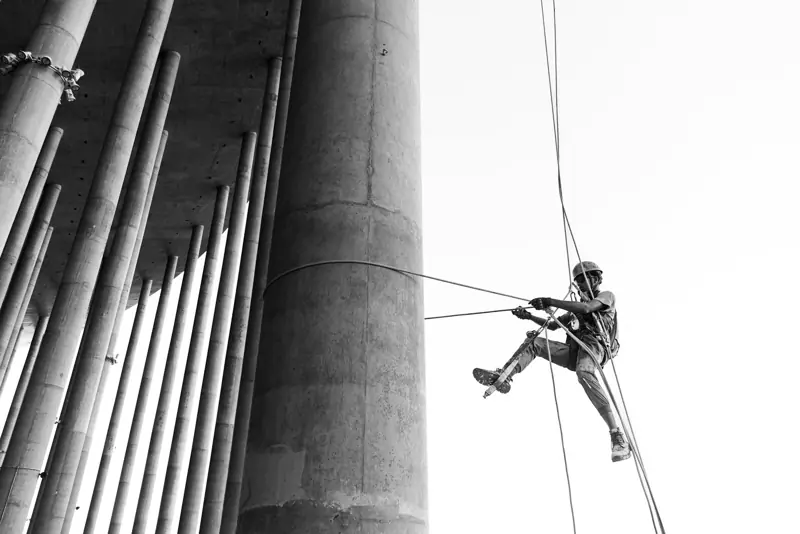


Rope Access vs Scaffolding vs Gondola: Choosing Façade Access in Singapore
Rope access suits scattered, light façade tasks on tall buildings with quick set-up and little ground disruption. Gondolas suit repetitive work along full drops. Scaffolds suit heavy, concentrated or long-duration work on lower elevations. MEWPs suit low-level reach from good ground. All are governed by MOM's Work at Heights and Scaffolds Regulations, with PE design required for anchorages and gondola outriggers.
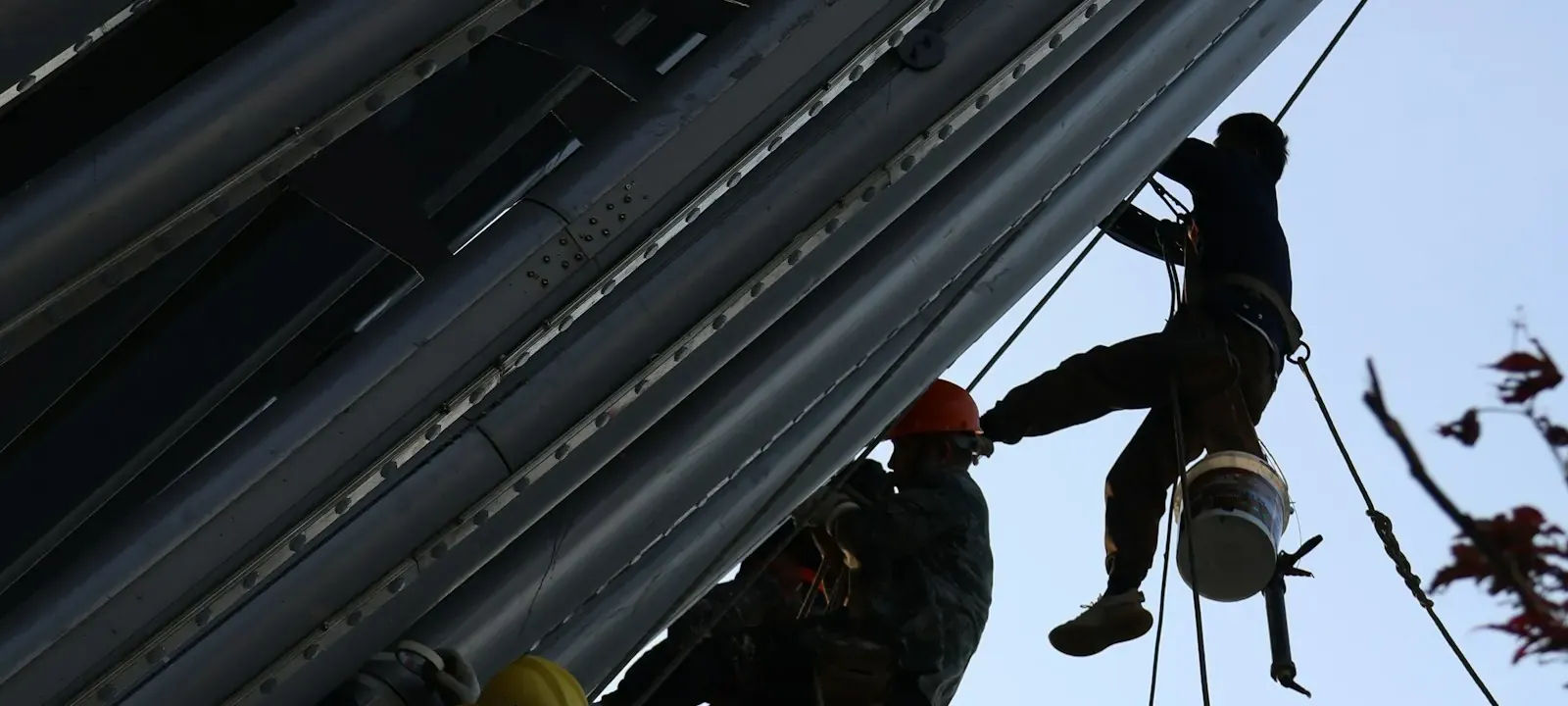
Every façade job in Singapore starts with the same question: how do we get people safely to the wall? The answer drives cost, programme, disruption to occupants and, above all, risk. Falls from height account for more than a third of workplace fatalities in Singapore each year, according to the Workplace Safety and Health Council.2 The access method is not a detail to leave to the contractor’s habit.
This guide compares the four main access methods used for façade inspection, cleaning, repair and replacement in Singapore: industrial rope access, scaffolding, suspended scaffolds (gondolas) and building maintenance units, and mobile elevating work platforms (MEWPs) including mast climbers. It sets out the legal framework under the Workplace Safety and Health Act, the specific requirements for each method, how rope access competence is demonstrated, and a matrix of time, cost and disruption trade-offs, including when each method is the wrong choice.
If you are planning access for a Periodic Façade Inspection, note that BCA’s PFI FAQ places the duty to provide the necessary access system on the building owner.9 For the owner’s broader legal exposure, read our guide to work-at-height law and occupier liability.
The legal framework in one table
| Instrument | What it governs | Source |
|---|---|---|
| Workplace Safety and Health (Work at Heights) Regulations 2013 | All work at height: fall prevention plans, permit-to-work, guard-rails, fall arrest, anchorages, and industrial rope access (Part IV) | 1 |
| Workplace Safety and Health (Scaffolds) Regulations 2011 | All scaffolds, including suspended scaffolds (gondolas): approved contractors, erectors, supervisors, inspection, design | 4 |
| Code of Practice for Working Safely at Heights (2013) | Approved code of practice on fall prevention | 312 |
| SS 588 Parts 1 and 2 (2013) | Rope access systems: fundamental principles and code of practice | 3 |
| SS 598:2014 | Code of practice for suspended scaffolds | 36 |
| SS 616:2016 | Code of practice for safe use of mobile elevating work platforms | 3 |
| SS 280 Parts 1 and 2 | Specification for metal frame and modular scaffoldings | 3 |
| SS 528, SS 570 | Personal fall-arrest systems; anchor devices and horizontal lifelines | 3 |
| MOM Circular MOM/OSHD/2025-02 | PE design, inspection and installation of gondola outriggers and overhead supports | 6 |
The codes listed are among those approved by the WSH Council under the Workplace Safety and Health Act, in a notification effective 8 December 2025.3
Rules that apply to every method
Work at height, hazardous work at height, and the 3 m line
The Work at Heights Regulations define work at height broadly: work where a person could fall from one level to another and is reasonably likely to be injured. “Hazardous work at height” applies where a person could fall more than 3 metres.1 Façade work is almost always hazardous work at height.
Fall prevention plan
The occupier of every workplace listed in the First Schedule where work at height is carried out must establish and implement a fall prevention plan: a documented, site-specific plan to eliminate or reduce the risk of falls, made available to MOM inspectors on request. The Schedule includes any worksite, shipyards, certain chemical, pharmaceutical and semiconductor factories, and other factories employing 50 or more persons.1
Permit-to-work
For hazardous work at height in factories, the occupier must appoint a competent person as authorised manager and another as work-at-height safety assessor, and must implement a permit-to-work system.1 The supervisor applies for the permit; the safety assessor inspects the site and endorses the application; the authorised manager issues the permit; the permit is posted at the work area; and the authorised manager reviews the work daily and may revoke the permit.1 The WSH Council summarises the permit-to-work as mandatory for workplaces that are factories under the WSH Act.2 MOM’s guidance treats premises where building operations or works of engineering construction are carried out as factories.7
How a work-at-height permit typically runs on a façade job
- Hazard identification and method statement. The contractor’s supervisor identifies the work area, access method, anchorage and rescue arrangements.
- Application. The supervisor applies for the permit, addressed to the authorised manager and submitted to the work-at-height safety assessor.
- Assessment. The safety assessor inspects the site with the supervisor and endorses the application only if satisfied.
- Issue. The authorised manager issues the permit after checking risk controls and that workers have been briefed.
- Posting. The permit is displayed at the work area for the duration stated on it.
- Daily review. The authorised manager reviews the need for continued work daily and may revoke the permit or stop work.
- Close-out. The supervisor reports completion; a fresh application is needed if work is not finished within the permit period.
Guarding, fall protection and anchorages
Open sides or openings where a person could fall more than 2 metres must be guarded by guard-rails or barriers; where that is not practicable, a travel restraint system or, failing that, a fall arrest system must be provided. Guard-rail top rails must be at least 1 metre above the working surface.1 Anchorages and anchorage lines for travel restraint and fall arrest must be inspected by a competent person at the start of each shift, with defects removed from use and results recorded in a register kept for at least 2 years.1
Training and supervision
The responsible person must ensure that workers receive adequate safety and health training on work-at-height hazards before they work at height, and that work at height is carried out under the immediate supervision of a competent person.1
Penalties
Breaches of most of the core duties, including the fall prevention plan, training, supervision, guarding, fall protection, permit-to-work and rope access provisions, carry a fine of up to S$50,000, imprisonment of up to 2 years, or both.1
Method 1: Industrial rope access
Rope access uses two independently anchored ropes, a working line for movement and positioning and a safety line as backup, with the technician suspended in a harness. Part IV of the Work at Heights Regulations sets the legal minimum:1
- at least two independent lines (a working line and a safety line), a suitable harness, and a self-locking control device on the working line;
- equipment that is sound, maintained and marked for traceability;
- anchorages and lines installed in accordance with a Professional Engineer’s design, with the certified design kept on site;
- inspection of the system by a competent person each shift, with a register; and
- registers and design documents kept for at least 2 years.
SS 588 Parts 1 and 2 are the approved codes of practice for rope access systems.3
Rope access competence: what to ask for
The regulations require adequate training and competent supervision but do not prescribe one named certificate. In practice, façade contractors commonly use the international IRATA (Industrial Rope Access Trade Association) training, assessment and certification scheme. Under IRATA’s scheme there are three technician levels; progression from Level 1 to Level 2, and from Level 2 to Level 3, each require at least 1,000 hours of varied experience over at least 12 months, recorded in a logbook; and technicians must revalidate every three years.1011 IRATA permits only Level 3 technicians to act as rope access safety supervisors, and does not allow lone working.13
Rope access due diligence for owners
- Ask for each technician’s current certification and level, and check expiry dates.
- Confirm a suitably senior (e.g. IRATA Level 3) technician will supervise on site.
- Ask for the PE design for anchorages and lines, and confirm it is kept on site.
- Check the shift inspection register for anchorages and equipment.
- Ask for the rescue plan: how an incapacitated technician will be brought down, and how fast.
- Confirm the permit-to-work arrangements and who is the authorised manager and safety assessor.
- Confirm drop-zone cordons and how falling-object risk to the public is controlled.
Where rope access is strong
- Speed of mobilisation. Lines can be rigged in hours rather than days, which suits inspections, defect removal, sealant work and spot repairs.
- Reach. Technicians can reach recesses, fins, soffits and complex geometry that a cradle cannot follow.
- Low ground footprint. Only a drop-zone cordon is needed; entrances and car parks can often stay open with management.
- Scattered work. Defects spread across many elevations are reached by moving lines, not relocating heavy equipment.
Where rope access is unsuitable
- Heavy or bulky replacement, such as large glass units or stone panels, that needs lifting equipment and several people at one location.
- Work requiring a stable platform for prolonged hot works, heavy tools or extensive surface preparation over large areas.
- Roofs without suitable anchorage points, or where a PE cannot verify anchorage capacity.
- Areas where the public cannot be kept clear of the drop zone.
Method 2: Scaffolding
Scaffolds provide a fixed working platform at every lift. The Workplace Safety and Health (Scaffolds) Regulations 2011 apply.4
Approved scaffold contractor. No one may construct, erect, install, re-position, alter, maintain, repair or dismantle a scaffold unless they are an approved scaffold contractor, except for “excluded scaffolds”: tower scaffolds, trestle scaffolds, and other scaffolds less than 4 metres high when completed (excluding top handrails). Suspended scaffolds, hanging scaffolds and scaffolds on cantilever or jib supports are never excluded.4
Trained people. Erectors must have completed a training course acceptable to the Commissioner, and a scaffold supervisor must be appointed before erection, alteration or dismantling.4
Inspection. No scaffold may be used unless a scaffold supervisor has inspected it on completion, then at intervals of not more than 7 days, and after weather likely to have affected its strength or stability; results go into a register kept at the workplace.4 MOM’s FAQ confirms this applies to tower scaffolds too, regardless of height.5
PE design. MOM’s FAQ lists scaffolds that require PE design. These include metal scaffolds exceeding 30 metres in height (15 metres in a shipyard), scaffolds on cantilever or jib supports, scaffolds whose platforms carry more persons or load per bay than specified limits, and outriggers or overhead supports for suspended scaffolds.5 MOM also points to SS 659:2020, the Code of Practice for Scaffolds, for technical guidance.5
Where scaffolding is strong
- Heavy or concentrated work: recladding, large-area concrete repair, curtain wall replacement on lower floors.
- Multiple trades working simultaneously at different levels.
- Long-duration works where a stable platform improves quality and productivity.
- Work needing material storage at height (within the scaffold’s designed loading).
Where scaffolding is unsuitable
- Tall buildings where height pushes the scaffold into PE design and long erection times.
- Occupied buildings where scaffold blocks light, ventilation and views for months, or creates a security risk by giving access to upper floors.
- Sites without ground space or with public walkways that cannot be diverted.
- Short or scattered tasks, where erection and dismantling cost dominates.
Method 3: Gondolas (suspended scaffolds) and building maintenance units
A gondola is a suspended scaffold: a cradle hung from roof outriggers or other overhead supports on wire ropes, raised and lowered by winches or climbers. Under the Scaffolds Regulations, suspended scaffolds must have adequately long and strong outriggers properly fixed and anchored, galvanised suspension ropes long enough to lower the platform to the ground, and a platform within specified width limits, kept as close as practicable to the work face.4 Nobody may enter or leave the cradle unless it is at rest at a level affording safe access and egress, and no person under 18 may operate the raising or lowering mechanism.4
MOM’s Circular of 10 January 2025 tightened expectations on the supports:6
- all outriggers and overhead supports must be designed by a PE, with drawings and calculations, complying with the Scaffolds Regulations and taking guidance from SS 598:2014;
- the design must verify that the supporting structure can take the load, using approved and as-built drawings verified on site, or PE checks such as core tests where information is missing;
- outriggers must not be designed to sit on brick or block parapets, thin walls with one layer of reinforcement, or sloping parapets unless a PE has verified their strength;
- tie-backs must be anchored to roof beams or internal columns, independently of the suspension and safety ropes, and must not be anchored on rooftop installations such as solar panels or M&E services;
- the PE must endorse a site-specific layout plan and, after installation, inspect the supports and issue a Certificate of Inspection;
- the Authorised Examiner who tests and examines the suspended scaffold must check for PE certificates and must not certify any suspended scaffold without a PE design; and
- installation, repositioning and dismantling may be done only by an approved scaffold contractor.
Building maintenance units (BMUs) are permanently installed roof systems that move a cradle around the building. Where a building has a BMU, BCA’s PFI guidelines expect the CP to consider existing maintenance access and its suitability before choosing a method.8 Before relying on an existing BMU or gondola system for façade works, confirm with the owner and an Authorised Examiner that its certification is current and that it can reach the areas concerned.
Where gondolas are strong
- Repetitive work along full vertical drops: cleaning, repainting, close-range PFI inspection, re-sealing.
- Larger crews and more materials at the face than rope access.
- Buildings with existing BMUs or certified roof anchorage systems.
Where gondolas are unsuitable
- Roofs where outriggers cannot be supported, for example only masonry parapets without PE verification.
- Façades with deep setbacks, projections, fins or curved geometry that the cradle cannot follow closely.
- Short, scattered tasks where repeated repositioning (each needing re-checks) outweighs the benefit.
- Strong-wind periods; cradles are vulnerable to sway and must be managed accordingly.
Method 4: MEWPs, boom lifts, scissor lifts and mast climbers
Mobile elevating work platforms place workers in a platform raised by a boom or scissor mechanism; mast climbing work platforms climb a fixed mast tied to the building. BCA’s PFI guidelines name mast climbers, scissor lifts, boom lifts and motorised elevated work platforms as alternatives where a gondola is not feasible, and remind CPs that operators must hold the relevant certification and that all MOM work-at-height requirements apply.8 SS 616:2016 is the approved code of practice for the safe use of MEWPs.3
Where MEWPs are strong
- Low- to mid-level façades, canopies, porte-cochères, soffits and exterior ceilings.
- Quick, short visits with no roof rigging.
- Work needing a stable platform with tools and materials at modest height.
Where MEWPs are unsuitable
- Heights beyond the machine’s reach.
- Soft ground, slopes, basements below, or suspended slabs that cannot take outrigger loads without engineering checks.
- Sites without vehicle access, or where the machine would block fire engine access or public routes.
Trade-offs matrix
The ratings below are qualitative comparisons for typical façade works on a mid- to high-rise building. They are not quotes; the right answer depends on your scope, building and occupants.
| Factor | Rope access | Gondola / BMU | Scaffold | MEWP / mast climber |
|---|---|---|---|---|
| Set-up time | Short | Medium (PE design, installation, examination) | Long | Short (MEWP) to medium (mast climber) |
| Set-up cost | Low | Medium | High | Low to medium |
| Suitable heights | Any, subject to anchorage | Any, subject to roof support | Lower to mid-rise economically | Limited by machine reach |
| Scattered, light tasks | Excellent | Fair | Poor | Good at low level |
| Heavy or bulky replacement | Poor | Fair | Excellent | Good at low level |
| Large continuous areas | Fair | Good | Excellent | Fair |
| Ground footprint | Drop-zone cordon | Drop-zone cordon | Full perimeter footprint | Machine footprint and swing zone |
| Disruption to occupants | Low | Low to medium | High (light, views, security) | Medium at ground level |
| Weather sensitivity | High (rain, wind, lightning stop work) | High (wind) | Lower | Medium |
| Key approvals and certifications | PE anchorage design; trained technicians; PTW | PE outrigger design and Certificate of Inspection; AE examination; ASC | ASC; scaffold supervisor; PE design above thresholds | Trained operators; ground checks |
The gondola that could not be hung
Composite scenario. An MCST books a gondola contractor for its first PFI close-range inspection and repainting, planning to use the old roof parapets for outriggers as was done years before. When the PE reviews the roof for the outrigger design required by MOM, the parapets turn out to be brick, and the as-built drawings are incomplete. Core tests and redesign follow, with steel frames tied back to roof beams. The inspection deadline is close, so the MCST writes to BCA for an extension, while the repainting contractor, already mobilised, claims standing time. Had the access been planned with the PE at the advisory stage, a year before the notice, the roof could have been assessed and the frames procured without pressure, or rope access used for the inspection and the gondola reserved for repainting.
Choosing: a practical decision path
Questions that decide the access method
- What is the task? Inspection, sealant, cleaning and spot repair favour rope access; heavy replacement favours scaffold or gondola.
- How is the work distributed? Scattered defects favour rope access; continuous work along drops favours gondola.
- What does the roof allow? Check anchorage and outrigger capacity with a PE early; masonry parapets are a red flag.
- What is below? Entrances, walkways, car parks and neighbouring property drive cordon and hoarding needs.
- Who occupies the building? Live premises may need night or weekend work and noise control.
- How long will it take? Long programmes justify higher set-up costs; short ones rarely do.
- What certifications exist? Existing BMUs or certified anchors may save time if current.
Working hours and noise matter for any of these methods in occupied buildings; see our guides on working in live premises and construction noise and working hours. For how access feeds into the PFI process, see our PFI guide, and for the repairs themselves, façade defect rectification.
How RRD approaches this
RRD’s façade works at height are carried out by rope access, covering glass cleaning, panel and cladding rectification, sealant, water-leak repair and spray painting; references include rope-access façade works at Biopolis 6 (April 2024) and façade and curtain-wall cleaning at the SIT2 campus (February 2024). Where a task suits a fixed platform better, RRD has also managed scaffolding, for example the scaffolding and panel installation in the Fu Lu Shou Complex atrium (September 2023). Each job begins with a site survey to choose the access method, a safety briefing before work starts, and supervised works. RRD holds bizSAFE Level 3. See façade works at height.
Key takeaways
- Façade work is hazardous work at height; fall prevention plans, permits-to-work, training and competent supervision apply regardless of access method.
- Rope access needs two independent lines, PE-designed anchorages and competent technicians; IRATA certification is the common industry evidence of competence.
- Gondola outriggers and overhead supports must be PE-designed and PE-inspected, installed by an approved scaffold contractor and never on unverified masonry parapets.
- Scaffolds above 4 m (and all suspended scaffolds) need an approved scaffold contractor and inspection at least every 7 days; tall or cantilevered scaffolds need PE design.
- Choose by task, distribution of work, roof capacity, ground conditions and occupancy, not by habit or day rate.
See the glossary for definitions, or contact us to discuss access for your façade.
Questions people ask
Is rope access legal for façade work in Singapore?
Yes. The Workplace Safety and Health (Work at Heights) Regulations 2013 contain a part on industrial rope access systems. They require at least two independent lines, a working line and a safety line, with a suitable harness and a self-locking device on the working line; anchorages and lines installed to a Professional Engineer's design; and inspection by a competent person each shift. SS 588 Parts 1 and 2 are approved codes of practice for rope access.
Which rope access certifications are recognised in Singapore?
The regulations require workers to be adequately trained for work at height and rope access systems to be used under competent supervision, but they do not name a single certificate. In practice, many façade contractors use the international IRATA scheme, which has three technician levels and three-yearly revalidation. Ask the contractor for each technician's current certification and logbook, and check what your main contractor's or site's safety management system requires.
Who is responsible for providing access for a PFI close-range inspection?
BCA's PFI FAQ lists providing the necessary access system, such as a suspended working platform or gondola, mobile elevating work platform, scaffold or a combination, among the building owner's responsibilities. The Competent Person plans the method of inspection and must ensure that work-at-height requirements are met and that operators hold the relevant certification.
Do gondolas need a Professional Engineer?
Yes, for the supports. MOM's January 2025 circular requires all outriggers or other overhead supports for suspended scaffolds to be designed by a PE, installed only by an approved scaffold contractor, and inspected by a PE who issues a Certificate of Inspection. The Authorised Examiner who tests and examines the gondola must not certify any suspended scaffold without a PE design.
When is a permit-to-work required for façade work?
The Work at Heights Regulations require a permit-to-work system for hazardous work at height, meaning work where a person could fall more than 3 metres, in workplaces that are factories under the WSH Act. MOM treats premises where building operations or engineering construction are carried out as factories. The occupier appoints an authorised manager and a work-at-height safety assessor, and no hazardous work at height may start without a permit.
Can gondola outriggers be fixed to a brick parapet?
MOM's 2025 circular says outriggers or overhead supports must not be designed to be installed on parapet walls of brick or block masonry, thin walls with one layer of reinforcement, or sloping parapets, unless a PE has verified their strength and integrity. Where information on the existing structure is incomplete, the PE must check it, for example by core tests or non-destructive tests.
Do I need an approved scaffold contractor for a small scaffold?
Only scaffolds that are excluded need no approved scaffold contractor. These are tower scaffolds, trestle scaffolds, and other scaffolds less than 4 metres high when completed, excluding handrails at the top lift. Suspended scaffolds, hanging scaffolds and scaffolds on cantilever or jib supports are never excluded. Every scaffold, including tower scaffolds, must be inspected by a scaffold supervisor before use.
Which access method is cheapest?
It depends on the scope. Rope access usually has the lowest set-up cost and is economical for scattered or light tasks on tall buildings. Gondolas become efficient when the same drop needs sustained work. Scaffolds cost more to erect and hire but suit heavy or concentrated work at lower levels. Compare total cost including set-up, duration, cordons, building disruption and any PE design, not the day rate alone.
Sources
13 sources. Official sources are marked dark. Links were checked when this guide was last updated.
- sso.agc.gov.sgWorkplace Safety and Health (Work at Heights) Regulations 2013 (S 223/2013), regs 2, 5–12, 20–31 and First Schedule. Official text: https://sso.agc.gov.sg/SL/WSHA2006-S223-2013 ; text read via mirror https://littdb.sfo2.cdn.digitaloceanspaces.com/litt/SG/SSOStatutes/subsidiary_legislation/WSHA2006-S223-2013.html (accessed Nov 2026) ↩↩↩↩↩↩↩↩↩↩
- tal.sgWorkplace Safety and Health Council — “Preventing Falls from Heights”. https://www.tal.sg/wshc/Topics/Work-at-Height/Preventing-Falls-from-Heights (accessed Nov 2026) ↩↩
- assets.egazette.gov.sgGovernment Gazette No. 5740 of 28 November 2025 — Workplace Safety and Health (Approved Codes of Practice) Notification 2025, effective 8 December 2025. https://assets.egazette.gov.sg/2025/Government%20Gazette/Notices%20under%20other%20Acts/5740.pdf (accessed Nov 2026) ↩↩↩↩↩↩↩↩↩
- inetapps.nus.edu.sgWorkplace Safety and Health (Scaffolds) Regulations 2011 (S 518/2011), regs 4–6, 26, 42, 48; informal consolidation hosted by NUS Office of Safety, Health and Environment. https://inetapps.nus.edu.sg/osh/portal/general_safety/legal_pdf/WSH_(Scaffolds)_Reg_2011.pdf (accessed Nov 2026) ↩↩↩↩↩↩↩
- mom.gov.sgMinistry of Manpower — “Scaffold Contractor FAQ”. https://www.mom.gov.sg/-/media/mom/documents/safety-health/scaffold-contractor-faq.pdf (accessed Nov 2026) ↩↩↩
- mom.gov.sgMinistry of Manpower — Circular MOM/OSHD/2025-02, “Safe Design and Installation of Outriggers or Overhead Supports for Suspended Scaffolds”, 10 January 2025. https://mom.gov.sg/-/media/mom/documents/safety-health/circulars/2025/circular-20250110-safe-design-and-installation-of-outriggers-or-overhead-supports.pdf (accessed Nov 2026) ↩↩↩↩
- mom.gov.sgMinistry of Manpower — “What is a factory”. https://www.mom.gov.sg/workplace-safety-and-health/factory-notification-and-registration/what-is-a-factory (accessed Nov 2026) ↩
- isomer-user-content.by.gov.sgBuilding and Construction Authority — “Guidelines on Periodic Façade Inspection”, Version 1.3, September 2026, section 6.2. https://isomer-user-content.by.gov.sg/338/51a06852-15e6-4a07-936c-2fa211f8c928/PFI%20Guidelines_V1.3.pdf (accessed Nov 2026) ↩↩
- isomer-user-content.by.gov.sgBuilding and Construction Authority — “Periodic Façade Inspection (PFI) FAQs”, Q8. https://isomer-user-content.by.gov.sg/338/4f099ad5-3a38-434f-9b81-0a52da31ba91/pfi-frequently-asked-questions.pdf (accessed Nov 2026) ↩
- irata.orgIRATA International — “Technician Step By Step Guide”. https://irata.org/page/technician-step-by-step-guide (accessed Nov 2026) ↩
- irata.orgIRATA International — “Training, Assessment and Certification Scheme (TACS)”, TC-101ENG. https://irata.org/uploads/documents/TC-101ENG_Training_Assessment_and_Certification_Scheme_(TACS)006_16.05.2023-001.pdf (accessed Nov 2026) ↩
- tal.sgWorkplace Safety and Health Council — “Code of Practice for Working Safely at Heights” (2013). https://www.tal.sg/wshc/-/media/tal/wshc/resources/publications/codes-of-practice/files/wsh-code-of-practice-2013_ebook.pdf (accessed Nov 2026) ↩
- irata.orgIRATA International — “Technicians FAQs”. https://irata.org/page/technicians-faqs (accessed Nov 2026) ↩
Use this guide in a report, a tender or a by-law briefing. Please link to the page so readers get the current version.